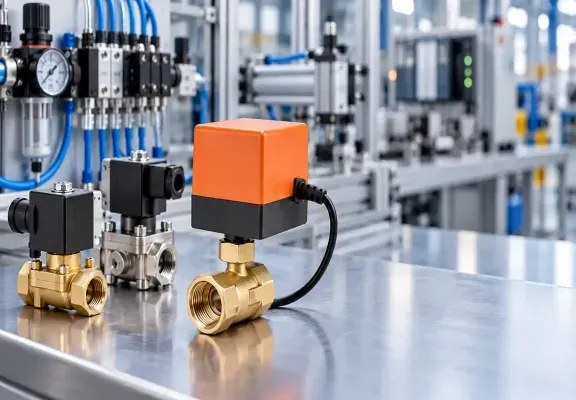
Anyone who has designed an automatic line can tell you that it's all about a small valve. When the solenoid valves are carefully programmed to open and close at the proper time, cylinders, grippers and actuators will do exactly what they are told. They do their work in silence, one cycle after another; one shift after another. Choose the wrong one, and it doesn't take long before the issues start to arise. Cycles slow down. Air leaks force up energy costs. Disruptions take a toll on production and customer orders.
This blog covers the types, uses and selection tips to help you make a confident purchase of industrial solenoid valves.
The solenoid valve is an electrically-operated valve. It has a coil, a movable plunger or spool, a body with ports, and seals. If the current is applied to the coil, the valve switches. It opens, closes or redirects flow. The most common industrial solenoid valves in factories are used for compressed air, but many are appropriate for water, oil and other compatible liquids.
Pneumatic solenoid valves connect the control system (PLC) to the moving components of a machine. Converts a small electrical signal to exact precision of air control. For this reason it is the focus of most automation configurations. The solenoid valve is an electrically-operated valve. It includes a coil, a movable plunger or spool, a body having ports, and seals. When the current is passed to the coil, the valve switches. It opens, closes or redirects flow.
Most frequently used industrial solenoid valves in factories are for compressed air systems, but many can be used for water, oil and other compatible liquids. Pneumatic solenoid valves are used to link the control system (PLC) to moving parts of a machine. Converts a small electrical signal to exact precision of air control. This is why it's the subject of most automation configurations.
It all starts at the coil. When energized, a magnetic field creates and attracts the plunger or spool. The movement of that passage causes opening or closure of the airway. When the power is removed, the valve is restored to its rest position via a spring.
There are two simple states relevant here:
Understanding the solenoid valve working principle helps to select the appropriate action for a loss of power. It is the starting point of all pneumatic valve circuits.
Solenoid valves are labeled based on their ports and positions. The following are the three most common types of solenoid valves found in Indian factories and workshops. Each is suited for a different occupation.
Two port solenoid valve and two positions 2/2 solenoid valve. It only turns flow on or off, depending on a signal, like a tap being opened or closed. It is used in air lines, blow-off systems and coolant lines and in other shut-off applications where only ON/OFF control is required.
A 3/2 way solenoid valve has three ports: inlet, outlet and exhaust. It charges one of the cylinders with air and vents it to push the piston back from the spring. Also suitable for small pneumatic tools, clamps and pressure switching. Simple and dependable.
5/2 solenoid valves are the most commonly used for double acting cylinders because they have five ports and two positions. Pumps piston out and back under the influence of the air. In a 5/3 solenoid valve, the centre position is an additional function that can be used to hold, exhaust or block the air. They both function as a directional control valve in assembly packaging and automated machines.
These valves act silently in controlling motion in small workshops and big production floors. The following are the key solenoid valve applications in the industry:
In all cases, the correct pneumatic automation relies on the appropriate valve operating cycle after cycle.
If you plan to buy something, find out a few specifications beforehand. If you get them right, choosing a solenoid valve is easy and you won't have to worry about poor machine performance. Here is how to choose solenoid valves that match your setup.
Double check the operating pressure range and the flow for your circuit. If the valve is too small, it will cause the cylinder to run out of oil and decrease the cycle speed. If it's too large, it's a waste of money and space. Use the correct solenoid valve for pressure rating and flow rate for load and allow for a small margin of safety.
The size of the port must be the same as your tubing and the desired air requirement of the actuator. Small ports fill up, create backups and pressure drops. Please check the thread standard (BSP or NPT) before ordering. If the solenoid valve port size is correct, then the air delivery remains steady.
Coils are available either AC or DC. Common options are 24V DC, 110V AC and 230V AC. Then there are two types of solenoid valves, namely DC solenoid valve which is put into the low voltage PLC circuits and AC solenoid valve which is used in the mains powered PLC circuits. Never match the solenoid valve coil voltage to your control panel and machine supply.
Typically a solenoid valve for air comes with brass or aluminum body and nitrile seals. Make sure that gases and liquids can be sealed into the same type of seal, check the media chart. Consider temperature restrictions, site conditions such as dust, moisture and vibration. The appropriate solenoid valve material contributes to service life.
There's a low cost valve and a high cost valve. Quality is evident in every performance:
Quality industrial solenoid valves require less maintenance, and maintain line productivity for longer. Every batch is tested by trusted solenoid valves manufacturers prior to dispatch.
It's as important to have the right partner as the right valve. These are the points to consider while comparing solenoid valves manufacturers and solenoid valves suppliers:
A reputable solenoid valve supplier, such as V.S Enterprises, will ask you about your application before recommending a valve.
Look for in-house manufacturing or for solenoid valve manufacturers in India, if they are found in India. Request assurances of quality, technical support and proper certifications. Can they be made in bulk and in special order? V.S Enterprises respond to these freely and give specifications as and when required.
The reliable solenoid valve suppliers in India are responsible for the common models of solenoid valves and they offer easy selection based on the size and voltage. V.S Enterprises will be able to assist the buyers of its products with application, provision of bulk quantity, delivery on time, after sales service. Replaceable coils and spares should also be readily available.
The decision between solenoid valves is based on valve type, pressure and flow, port size, and coil voltage and material compatibility. Combine these checks with reliable solenoid valves manufacturers in India and solenoid valves suppliers in India, and your machines operate flawlessly for years.
|
Contact V.S Enterprises and discuss your needs and they will be able to advise you on the correct valve for your type of application. |
A 3/2 valve controls single-acting cylinders, where a spring returns the piston. A 5/2 valve drives double-acting cylinders in both directions. Pick based on your cylinder type.
Match the pressure rating, flow capacity and port size to your cylinder's air demand. Keep a small safety margin. An undersized valve slows the cycle, and an oversized one wastes money.
They are used in packaging machinery, pneumatic cylinders, automation lines and material handling. They also serve compressed-air systems and general machine control. Any setup that needs automated air control can use them.
Yes, if the body and seal materials suit the liquid and its temperature. Always check the datasheet before use. Air valves should not be used with liquids unless the manufacturer confirms compatibility.
Look at build quality, testing practices, certifications and technical support. Ask if they can meet industrial volumes and custom needs. Reliable solenoid valves manufacturers share specifications openly.
Good solenoid valves suppliers keep popular models in stock and guide you on application. They offer bulk supply, timely delivery and dependable after-sales support. Spares like replacement coils should be easy to get.