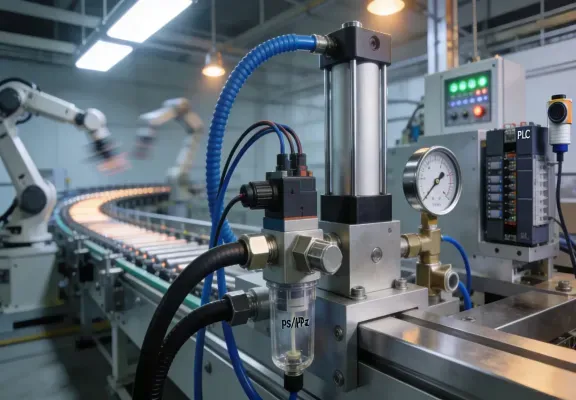
Contemporary production does not necessarily rely on hydraulic force or human labour. In many sectors, such as the automotive industry and food processing, pneumatic systems have become the foundation of intelligent automation of the factory, providing speed, accuracy, and scalability of energy efficiency. They cannot be replaced in high-throughput production because of their capacity to transform compressed air into controlled mechanical motion.
To procurement managers and plant engineers considering the industrial infrastructure, it is important to know the complete picture of the pneumatic technology, both in terms of the individual parts, as well as the entire circuit design, so that they could make effective investment choices. Upgrading an existing line or developing a green field facility, this guide will make you know all you need to source and specify pneumatic equipment.
A pneumatic system is a working fluid in which pressurised air is the medium to create linear or rotary mechanical motion. A pneumatic pump will draw in atmospheric air and compress and provide it to a network of components to actuators and end-effectors. The outcome is clean, quick and controllable force - without fire hazard and fluid pollution of hydraulic versions.
Compressed-air systems can be used in almost any area of discrete and process manufacturing due to their flexibility. The following table outlines the most prevalent industry verticals, as well as their major applications.
| Industry | Key Application |
|---|---|
| Automotive | Assembly lines, tyre inflation, body-panel stamping |
| Pharmaceuticals | Tablet pressing, blister packaging, sterile filling |
| Food & Beverage | Bottling, conveying, labelling, clean-room packaging |
| Textiles | Yarn tensioning, loom actuation, fabric handling |
| Electronics | PCB pick-and-place, soldering, precision positioning |
| Chemical Processing | Valve actuation, drum transfer, hazardous-area control |
Here are some of common types of pneumatic systems:
Here is a list of things that should be considered when choosing the pneumatic equipment:
Here are some of the reasons why you should prefer Indian manufacturers for pneumatic equipment.
Noida & the wider NCR industrial belt are evolving into a significant hub for precision engineering and industrial component manufacturing. For buyers choosing to consider the pneumatic system in Noida, the following structural advantages exist.
Beyond a supply channel for physical components, pneumatic traders in Delhi & authorised distributors have key roles to play. These include keeping a buffer stock of fast moving components, offering technical pre-sales assistance, allowing the multi-brand component sourcing from a single Purchase Order, and taking responsibility for processing warranty claims-thus minimizing purchase teams’ workload and unexpected plant downtime.
VS Enterprises (V.S. Pneumatics) is a well-respected distributor and authorized distributor of pneumatic components. The company has been supplying high-quality pneumatic and industrial automation components to customers in India since 2013. The product line includes pneumatic cylinders, solenoid valves, air regulators, PU tubing, one-touch fittings, actuators, foot pedals, and all other accessories required for a successful and efficient automated production system. The goal is to provide durable, high-performance components that enable manufacturing and production facilities to improve their operating efficiencies while reducing their downtime. VS Pneumatics serves the automotive, manufacturing, packaging, food processing, and construction industries. With years of experience in the pneumatic industry, VS Pneumatics will assemble successful and long-term relationships by providing an excellent quality product, customer service, and on-time delivery to the entire country of India.
Ans: A pneumatic system is an industrial automation system that uses compressed air to generate linear or rotary mechanical motion for machines, actuators, and automated equipment.
Ans: Pneumatic systems convert compressed air into controlled mechanical movement using cylinders, valves, and actuators. These systems integrate with PLCs and automation controls to improve production speed and accuracy.
Ans: Pneumatic systems support Industry 4.0 by enabling programmable automation, fast response times, energy-efficient operation, and seamless integration with smart manufacturing technologies.
Ans: The main components include pneumatic cylinders, air cylinders, pneumatic valves, compressors, pneumatic tubes, pneumatic pipes, pneumatic hoses, regulators, and actuators.
Ans: A pneumatic cylinder converts compressed air pressure into push or pull motion for industrial machinery and automation applications.
Ans: A pneumatic pipe is a rigid air distribution line used for main air supply systems, while a pneumatic hose is a flexible conduit designed for moving equipment and robotic applications.
Pneumatic technology continues to be a viable and robust foundation for any form of industrial automation, be it at a conventional plant or a nascent smart factory. An accurately specified pneumatic valve, actuator and distribution strategy from a reputable dealer will provide a production line's desired cycle-times, safety standards and uptime.
India’s manufacturing ecosystem allows procurement teams to work with technically skilled supply partners who understand the rigors and challenges of industrial production. The smart choice of working with tried-and-tested pneumatic dealers in India, especially those based within large industrial centers like Noida, gives businesses assurance of supply as well as technical support for local application requirements, and a flexible supplier partner for potential expansion.
Are you looking to upgrade your production line? Connect with us today, for industrial pneumatics advice and bulk supply.