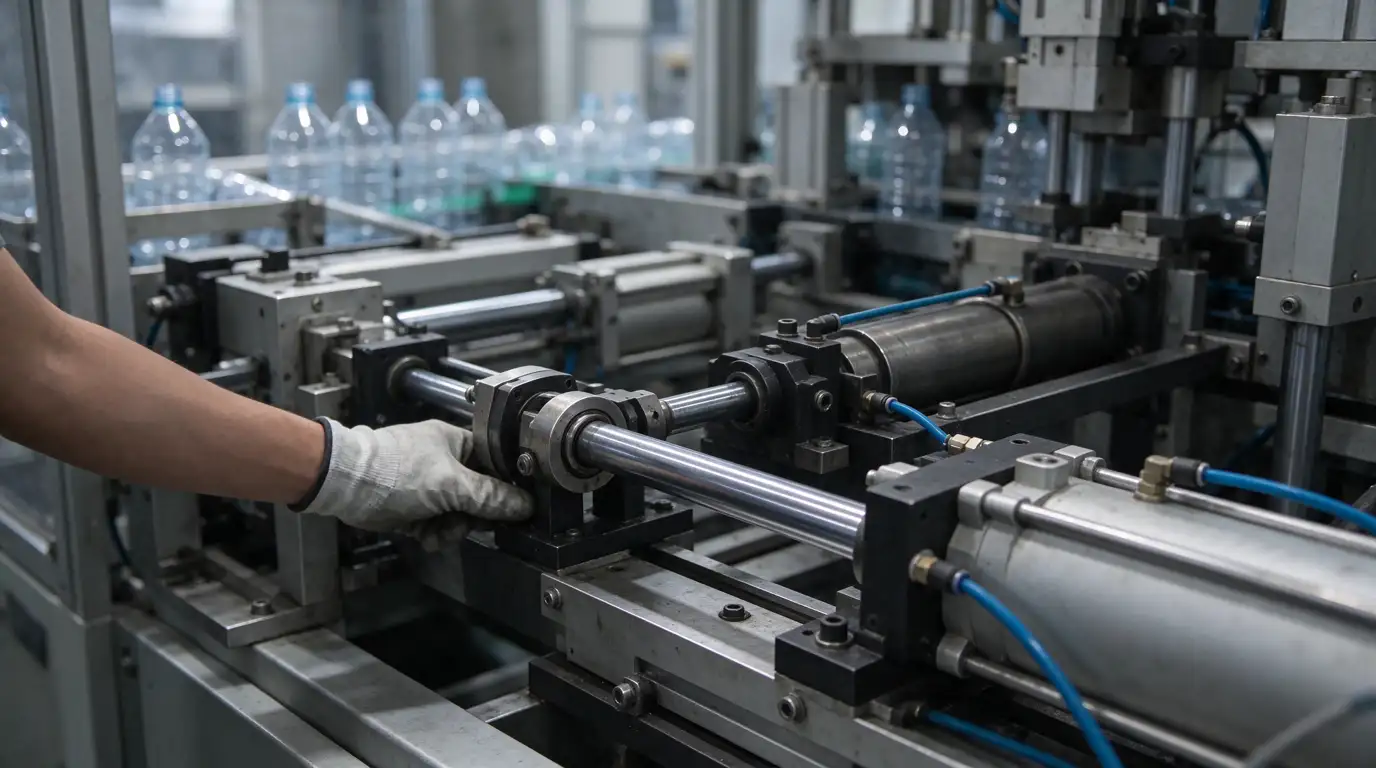
In the manufacturing equipment for PET, pneumatic movement is needed to perform a number of handling, positioning and machine operations. Cylinders For Pet Moulding Machine and PET Moulding Cylinders are subjected to repeated extension and retraction during the production. There can be friction and mechanical stress on seals and other internal parts over time using frequent cycling. This information will help maintenance personnel identify these cylinders' performance characteristics in the event of long hours of operation and keep the machine running in peak condition.
There are two basic motions to be discussed, extension and retraction, in Pneumatic Cylinder Cycling. The piston rod is extended by compressed air pushing the piston out. In the retraction phase air pressure drives the piston in the other direction. These movements are repeated based on the machine's sequence of operation.
Seals are used to keep the pressure in PET Moulding Cylinders, as the piston and rod slide along the surface. Components may wear out over time if they are subjected to repeated contact. But, the actual wear rate is a function of operating pressure, cycle speed, alignment, air quality, loading conditions and maintenance practices, not just cycle count.
Pneumatic Cylinder Wear may be caused by repeated use, causing friction, pressure and mechanical stress on various parts. Knowing the factors is essential for the Cylinder Durability, and for the study of any possible performance problems. Some of the following seven points describe where wear can be found and how wear affects the operation of the cylinder.
In these applications, piston and rod seals, or PET Cylinder Seals, hold the correct amount of air pressure in a pneumatic cylinder. These seals are in constant contact with sliding surfaces when the seal is repeated.Over time they can deteriorate as a result of friction, contamination and inadequate lubrication.
Pneumatic Cylinder Seal Wear may result in an air leak between the cylinder chambers or around the piston rod. Leaky seals will mean the machine will not move as efficiently and may affect the force the machine has for moving. Inspecting seal conditions on a regular basis and changing seals in accordance with manufacturer's recommendations can help to avoid additional performance issues.
During the operation of each cycle, the piston rod passes through a guide/bearing assembly. Uneven contact between the rod and its guide can occur if the rod is not properly aligned or subjected to excessive side loading.
Pneumatic Piston Rod Wear can manifest itself over time as scratches on the surface, scoring or finish changes on the rod. The sliding surfaces can also be damaged by contaminants entering the cylinder. Cylinder Guide Wear may cause increased movement resistance and may affect alignment. These problems can be detected by checking the condition of the rods, mounting accuracy and external contamination.
The speed of pneumatic cylinder is suitable and stable according to the requirement of the machine. But, constant cycling can show movement changes due to seal friction, leakage or mechanical resistance.
Pneumatic Cylinder Stroke Speed can also be influenced by differences in the pressure of the compressed air, Flow control valve settings, tubing restriction, as well as the load being moved. Don't assume that slow, erratic engine speed is because of cylinder wear, therefore.
Cylinder Motion Problems should be investigated by maintenance teams as a whole, including the air supply, valves, fittings and cylinder components. This will help to determine the real reason for an irregular movement.
Pneumatic cylinders also have stopping forces when the piston stops extending or retracting. Cushioning arrangements aim to control the piston movement close to the end position and thus reduce the impact.
The cushioning components can be slowly affected by repeated stopping forces, especially if the cylinder speed and the moving load are beyond design.
It is therefore advisable for Pneumatic Cylinder Cushioning to be checked periodically for proper adjustment and operation. If too much impact is applied, this could result in abnormal knock noises, vibration or stress on mounting structures. Repeated operating these forces are managed by correct cylinder sizing and cushioning settings.
Another issue that could arise throughout the use of the pneumatic is air leakage. Eventually, piston seals can deteriorate and allow compressed air to leak between the chambers. Seals may also become ineffective and air could leak out.
In Pneumatic Cylinder Air Leakage can cause the loss of air pressure required for motion, higher compressed-air usage and inconsistent operation. Sometimes the issue could be caused by broken pipes, leaking joints or valves.
Maintenance teams should isolate the cylinder and check the pneumatic circuit to which it is connected to accurately diagnose PET Machine Cylinder Problems. Once the leakage source is found, it may be possible to avoid replacing an unnecessary component.
A pneumatic cylinder needs to be installed with appropriate mounting features that accommodate load(s) and the direction of movement. Over repeated use, it may become apparent if fasteners are loose or if the assembly is not stable or aligned, especially if under vibration or improper mechanical loading conditions.
Side forces may be introduced on the piston rod due to Incorrect Pneumatic Cylinder Alignment. These forces can lead to more wear on guides, seals and connecting components.
Cylinder Mounting Wear should be checked periodically using Cylinder Mounting Brackets, Cylinder Mounting Fasteners, Cylinder Mounting Joints and Cylinder Mounting Surfaces. The alignment and installation will reduce the mechanical stress and facilitate smooth movement.
Compressed air quality directly impacts on the operation of the pneumatic cylinder. Inside the pneumatic circuit moisture, dust and other contaminants can enter, impacting seals, internal surfaces, and connected valves.
Pneumatic Cylinder Air Quality is best achieved by using proper Filters, moisture separation and periodic inspection of equipment to prepare air. Also, lubrication should be done according to the cylinder manufacturer's recommendations as the use of the wrong lubricants could impact the materials used for the seals.
Similarly, the operating pressure and temperature should not exceed the specified values. Cylinder Operating Pressure may be Incorrect, affecting both the available force and operating behaviour. The above conditions can lead to excessive wear under circumstances other than an unusually high cycle rate.
Not all the time does Pneumatic Cylinder Wear lead to a breakdown. In many instances, performance variations take time to become apparent, and only during normal production.
The maintenance teams should be on the lookout for the following PET Moulding Cylinder Failure Signs:
These symptoms can also be caused by valves, sensors, air supply issues or mechanical blockages. The performance of the affected cylinder compared with its normal operating behaviour can help maintenance teams narrow down the cause.
With the right care, the service life of the cylinder can be extended and minimized downtime of PET manufacturing. Maintenance crews shouldn't wait until the component fails, but should use a planned inspection approach.
These are some of the best practices for Pneumatic Cylinder Maintenance:
These Cylinder Wear Prevention practices can help detect potential issues early on. Maintenance schedules will be determined by operating conditions, manufacturer's recommendations and the condition of the equipment.
Some cylinder problems do not call for total cylinder replacement. Certain issues like damaged seals or faulty connections can be fixed with proper upkeep or servicing of components. But for replacement should be taken into consideration if the cylinder is leaking persistently, there are damaged surfaces on the rod, there are excessive guide wear or there are issues in the movement.
Prior to the PET Machine Cylinder Replacement, maintenance personnel should check the following specifications:
These details are needed to be sure that the replacement cylinder is compatible with the existing machine. By taking advice from experienced Pneumatic cylinders suppliers, buyers can also determine whether the specifications are suitable for their application.
While selecting the appropriate pneumatics, it is essential to take into account the size and construction of the cylinder, sealing and mounting. V.S. Enterprises, a renowned name among pneumatic cylinder suppliers in Noida, is a reliable supplier of pneumatic products for different industrial applications such as PET moulding machinery. The buyers can consult the bore size, stroke length, operating pressure, mounting configuration and machine requirements before selecting Cylinders For Pet Moulding Machine. Knowing the type of machine being used and any existing cylinder data can be useful in determining which cylinder types will work together without any issues.
These are the common problems that occur in PET Moulding Cylinders over time due to repeated cycling: Seal deterioration, Piston rod wear, Cushioning problems, Air leakage and mounting stresses. If these problems are not detected early, they can affect the speed of stroke, the consistency of movements and how the machine operates in general. Regular checking of the condition of the cylinder and use of clean compressed air, correct alignment and appropriate operating pressure are important in controlling cylinder wear.
Buyers should take into account the operating requirements, part compatibility, and maintenance requirements when ordering Cylinders For Pet Moulding Machine parts. V.S. Enterprises can help the industrial buyers in selecting the right pneumatic cylinder as per their machine specification, operating conditions, application requirements.
|
For reliable pneumatic cylinders for PET moulding machine applications, Contact V.S. Enterprises. Talk about your cylinder needs and find the solutions which are suitable for your industrial needs. |
The repeated movement of seals, rods and guides can lead to wear as a result of frequent Pneumatic Cylinder Cycling. However, the loading and operating pressures, air quality, alignment, maintenance and manufacturers' cycle ratings also affect the service life.
Pneumatic Cylinder Seal Wear typically occurs at multiple locations: air leakage, inconsistent movement, loss of operating force and stroke variations. But the same symptoms can also occur due to defective valves, fittings or compressed-air supply issues.
Yes. The PET Machine Cylinder Performance may be impacted by worn seals, increased friction or damaged sliding parts. If the movement of the cylinder is a critical component of the machine sequence, different extensions can affect the production time as a whole.
The frequency of inspection depends on the use of the machine, operating conditions and on the maintenance advices provided by the manufacturer of the cylinder. If equipment is running, or under heavy duty, more frequent checks may be necessary. Leakage condition, condition of rods, mounting fasteners and stroke consistency should be part of the maintenance team's inspection.
In some cases, yes. With the cylinder body and piston rod and major components in good condition, it may be possible to restore performance by replacing worn seals or by servicing some components. However, if there is considerable damage to the rods or other problems in the scoring or frame, it may be necessary to replace them.
The cylinder bore and stroke, operating pressure, type of mounting, piston rod size and connections must be provided by the purchaser. The type of seal material and the working conditions in which the machine is used should also be considered with the aim of achieving suitability for the application.