In today’s times, imagining a world without pneumatic components is impossible. They are found almost everywhere – from the food industry to the automotive industry. They are an excellent choice for tasks that require accuracy and speed. They are vital for any industry, as they keep the operations seamless. Some of the basic pneumatic components include pneumatic tools, air cylinders, pneumatic actuators, and more. If you are a business owner looking for pneumatic components, your choice can make or break your business operations.
This blog will guide you in choosing the right pneumatic components based on your business needs. Let us talk more about it.
Pneumatics involves the use of compressed air to perform work. It finds application in numerous industries such as manufacturing, automobile, construction, and food processing. Machines can be operated by using pneumatic parts, which transfer compressed air into motion, whether in a straight direction (linear) or circular motion.
There are benefits of pneumatics, which include:
When selecting pneumatic components, you need to consider what you need, the amount of power needed, the space available, and operating conditions.
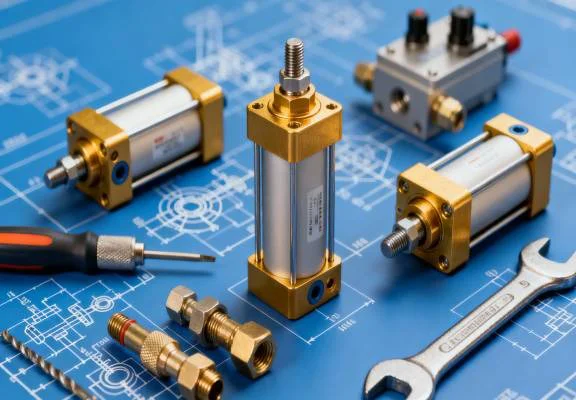
A pneumatic system requires Pneumatic Cylinders as important components. They convert compressed air to straight-line motion (push or pull). These types of cylinders find application in activities such as lifting, pressing or moving things. In selecting pneumatic cylinders, the following are the key considerations:
For example:
The single-acting cylinders involve the use of a spring to put the piston back at its starting point.
The double-acting cylinders rely on air pressure to lengthen and shorten the piston.
Pneumatics uses compressed air to do work. It’s used in many industries like manufacturing, automotive, construction, and food processing. Pneumatic components turn compressed air into motion, either moving in a straight line (linear) or rotating, so machines can perform tasks.
Some advantages of using pneumatics include:
When picking pneumatic components, it's important to think about your specific needs, the power required, how much space you have, and the operating conditions.
Pneumatic cylinders are key parts in a pneumatic system. They change compressed air into straight-line motion (push or pull). These cylinders are used for tasks like lifting, pressing, or moving things.
When choosing pneumatic cylinders, here are the main things to consider:
| Type | Description | Ideal Use Case |
|---|---|---|
| Single-Acting Cylinder | Uses a spring to return the piston. | Low-force applications, short strokes. |
| Double-Acting Cylinder | Requires air pressure for both directions. | High-force applications, longer strokes. |
| Rodless Cylinder | No external rod; the piston moves along a rail. | Limited space, precise linear movement. |
| Guided Cylinder | Built with a guide for more stable motion. | Heavy-load applications require stability. |
Each of these options comes with its own advantages and limitations, and selecting the right type is crucial for meeting your performance criteria.
Pneumatic Actuators Valve are components that convert compressed air into mechanical motion. While pneumatic cylinders are for linear (straight-line) movement, actuators can do both linear and rotary (rotating) movements.
When selecting pneumatic actuators, keep these factors in mind:
| Type | Description | Ideal Use Case |
|---|---|---|
| Rotary Actuators | Provides rotary motion. | Assembly lines, robotics, turntables. |
| Linear Actuators | Provides linear motion. | Material handling, presses, conveyors. |
| Tie-Rod Actuators | Compact design with threaded rods. | Small, space-constrained environments. |
| Pneumatic Grippers | Used to grasp and manipulate objects. | Pick-and-place applications, robotics. |
Compressed air pneumatic tools are applied in industries in processes such as drilling, sanding, and tightening of bolts. These are tools that are characterised by speed and efficiency.
The following are some of the considerations that should be made when selecting pneumatic tools:
Other equipment such as filters, regulators, and lubricators (FRLs) may be included in pneumatic systems besides the primary components, such as pneumatic cylinders and actuators, which are important in maintaining a healthy pneumatic system.
The environment in which you will put your pneumatic system also should be considered by you. To elaborate, in case your equipment will be subjected to heat, moisture and harsh chemicals, then you must select materials that can withstand these circumstances.
Here's what to consider:
You should choose a supplier that is good, and who realizes your business and what you require. Not only can a good supplier provide parts, but also good advice and constant assistance.
When selecting a supplier, use:
Experience in the industry: the supplier can be able to guide you in the type of parts to use in your system.
Availability: Ensuring that the supplier is able to supply parts fast enough to ensure that your system is online.
After sales services: A proper supplier will assist you in troubleshooting, maintenance guidance and employee training.
You must know what you need to do, and should know that before all. Understand whether you require a single-acting cylinder, a double-acting cylinder, the amount of load is required etc.
The fundamental distinction between Pneumatic cylinders and pneumatic cylinders is in their movement. On the one hand, pneumatic actuators provide both - linear and rotary motion, whereas pneumatic cylinders provide only one - linear motion.
Some of the factors to be put into consideration before deciding to invest in pneumatic tools are as follows:
Air requirement
Tool's Size
Tool's Weight
Durability
A pneumatic system has filters and regulators as a significant component. To ensure that the components are always dust-free, filters are important. On the same note, the regulators will be essential in making sure that the pressure of air is controlled. Without any regulators, machine parts can get spoilt in case the pressure is considerable.
Yes. V.S. Pneumatics has a variety of solutions that may be applied in case of high temperatures. We would like you to access our web site and select goods that may easily deal with extreme conditions such as heat, chemicals etc